
PM congratulates Major Abhilasha Barak on being conferred the UN Military Gender Advocate of the Year Award

| Published on:

Prime Minister Shri Narendra Modi today congratulated Major Abhilasha Barak on being conferred the UN Military Gender Advocate of the Year Award. The Prime Minister noted that Major Barak is serving as an Engagement Team Commander and Gender Focal Point within the United Nations Interim Force in Lebanon (UNIFIL).

Shri Modi observed that this honour is a recognition of her exemplary service and also of India’s longstanding contribution to United Nations peacekeeping efforts.

The Prime Minister stated that her achievement is also an inspiration to countless young Indians, especially the daughters of the nation, who aspire to serve the country and humanity.

The Prime Minister posted on X:

“Congratulations to Major Abhilasha Barak on being conferred the UN Military Gender Advocate of the Year Award. Major Barak is serving as an Engagement Team Commander and Gender Focal Point within the United Nations Interim Force in Lebanon (UNIFIL). This honour is a recognition of her exemplary service and also of India’s longstanding contribution to United Nations peacekeeping efforts. Her achievement is also an inspiration to countless young Indians, especially our daughters, who aspire to serve the nation and humanity.”

Union Home Minister offers prayers at the Bhagwan Ayyappa Temple in New Delhi

| Published on:

Union Home Minister and Minister of Cooperation Shri Amit Shah today offered prayers at the Bhagwan Ayyappa Temple in New Delhi and inaugurated the newly constructed SABAREESAM Complex in the temple premises.

In a post on X,  Union Home Minister, Shri Amit Shah said, “Fortunate to offer puja at Bhagwan Ayyappa temple, in R.K. Puram, New Delhi. Bhagwan Ayyappa is the bestower of bliss and the emodiment of the sacred values that unites our nation. Prayed to the deity for the well-being and prosperity of all.”

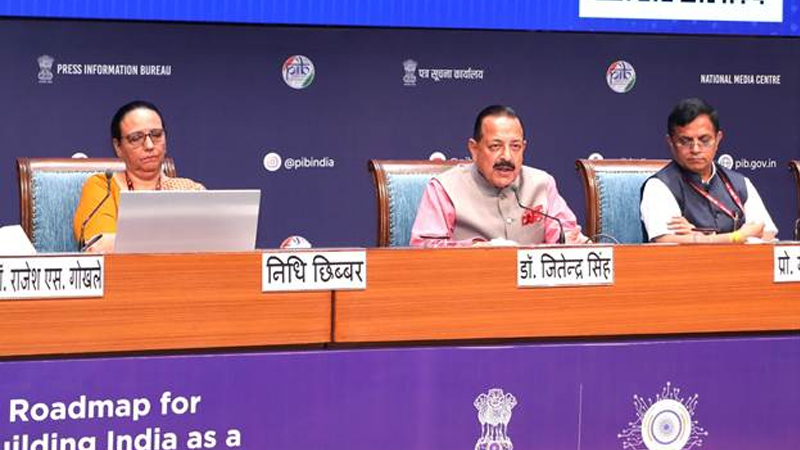
12 Years of Modi Government Have Created an Aspirational India: Dr. Jitendra Singh

| Published on:

Twelve years of the Narendra Modi government have transformed India into an aspirational nation driven by opportunity, innovation and self-belief, Union Minister Dr. Jitendra Singh said on Sunday while talking to media, asserting that governance reforms, technological democratisation and citizen-centric policies have fundamentally changed the way Indians perceive their prospects. The Minister also outlined the next phase of growth, stating that India’s space economy, currently close to $9 billion, is expected to expand to about $45 billion over the next seven to eight years as the country advances towards the goal of becoming a developed nation by 2047.

Reflecting on Prime Minister Narendra Modi’s 4,399 days in office as a continuously serving elected Prime Minister, Dr. Jitendra Singh highlighted a range of measurable outcomes over the past decade. He said India’s space startup ecosystem had grown from a single-digit number of startups a few years ago to around 400 today, with one startup recently attaining unicorn status. India’s space economy is now valued at nearly $9 billion and is projected to reach $45 billion by the end of the next seven to eight years. The Minister said the country’s startup ecosystem had expanded from about 350-400 startups in 2014 to more than 2.3 lakh at present, generating nearly 24-25 lakh jobs. Nearly half of these startups are located in Tier-II and Tier-III cities, while 35-39 per cent are women-led. He also noted that a recent space launch witnessed the participation of around 1,500 media personnel and nearly 10,000 spectators, reflecting growing public engagement with science and technology.

Dr. Jitendra Singh said some of the government’s earliest reforms symbolised a shift towards a citizen-centric governance model. He cited the decision to end the requirement of gazetted-officer attestation of documents and permit self-attestation as a landmark step that signalled trust in citizens, particularly the youth. The Minister also referred to the abolition of interviews in several categories of government recruitment, saying the move reduced opportunities for nepotism, discretion and malpractice while strengthening merit-based selection. These reforms helped create confidence that success could be achieved through ability and hard work rather than influence or recommendation, the Minister added.

Arguing that the most profound change of the past 12 years has been psychological, in addition to procedural, Dr Jitendra Singh said India had witnessed the rise of a new aspirational culture. “The change of mindset that has happened in the last 12 years under Prime Minister Modi is one of the biggest hallmarks,” he said. “The kind of aspirational surge that has happened — ‘I can also do it’ — was not there earlier.” The Minister said this shift was visible in the growing number of civil services toppers emerging from small towns and non-metropolitan backgrounds, reflecting the democratisation of opportunity through technology, transparency and fair competition.

The Minister also linked India’s scientific achievements to this broader transformation. Referring to the Chandrayaan missions, he said the government had fostered a culture in which citizens increasingly identify with national scientific achievements and view innovation as a shared national endeavour. He recalled that Prime Minister Modi encouraged scientists after setbacks and celebrated their successes, helping normalise the idea that failure is a part of innovation and progress. Dr. Jitendra Singh said India’s successful landing near the Moon’s south pole had strengthened public interest in science, while earlier discoveries by Indian lunar missions had helped identify evidence of water molecules on the Moon.

Highlighting institutional changes, Dr. Jitendra Singh said the Modi government had opened strategic sectors such as space and parts of the nuclear ecosystem to private participation, ending decades of restricted access. He said these sectors had traditionally operated behind closed doors but were now integrated with industry, entrepreneurs and startups. According to the Minister, this policy shift had expanded career opportunities, accelerated innovation and aligned India’s scientific ecosystem with global best practices. He also noted that initiatives such as Viksit Bharat reflected a broader emphasis on benchmarking India’s progress against international standards rather than domestic comparisons alone.

The Minister further argued that welfare delivery had also moved towards universal and transparent implementation. Referring to housing and other welfare programmes, he said benefits were being delivered without discrimination based on caste, religion or any other affiliation, creating greater trust in public institutions and governance systems.

Looking ahead, Dr. Jitendra Singh said India’s development journey would require deeper public-private collaboration, stronger participation of women and youth, continued expansion of emerging sectors such as space, nuclear energy and quantum technologies, and adherence to global standards of performance and innovation. The Minister maintained that the government’s long-term objective was not merely economic growth but the creation of an empowered and aspirational society capable of contributing to the vision of a developed India by 2047.

The remarks place the government’s 12-year record within a broader narrative of governance reform, institutional transformation and an effort to shift India from a culture of entitlement and dependence towards one driven by aspiration, merit and innovation.

Prime Minister chairs meeting of the Economic Advisory Council to the Prime Minister

| Published on:

Prime Minister Shri Narendra Modi today chaired a meeting of the Economic Advisory Council to the Prime Minister. The Prime Minister noted that they deliberated on a wide range of issues relating to India’s economic transformation and long-term development priorities.

Shri Modi stated that perspectives were also shared on adding more momentum to the reforms journey and ensuring ‘Ease of Living’ as well as ‘Ease of Doing Business.’

The Prime Minister posted on X:

“Chaired a meeting of the Economic Advisory Council to the Prime Minister. Deliberated on a wide range of issues relating to India’s economic transformation and long-term development priorities. Also shared perspectives on adding more momentum to the reforms journey and ensuring ‘Ease of Living’ as well as ‘Ease of Doing Business.’

@EACtoPM”

BJP National President addresses Intellectual meet in Ranchi, Jharkhand

| Published on:

Bharatiya Janata Party National President Shri Nitin Nabin, while addressing the ‘Intellectuals’ Meeting’ organized in Ranchi on the first day of his Jharkhand visit on Saturday, stated that the central government is working with the goal of farmers’ welfare, agricultural reforms, and increasing their income. The BJP National President mentioned that initiatives like organic farming, Ayushman Bharat, Jan Dhan Yojana, Digital India, Startup, and Mudra Yojana are playing an important role in empowering the poor, farmers, women, and youth of the country. Shri Nabin described national security, elimination of Naxalism, development of railways and infrastructure, women’s empowerment, and preservation of cultural heritage as the major achievements of the government, and called upon the youth to contribute actively with positive politics, innovation, and in building Viksit Bharat-2047. During the program, Jharkhand BJP State President Shri Deepak Sahu, Leader of Opposition in Jharkhand Shri Babulal Marandi, Union Ministers Shri Sanjay Seth and Smt. Annapurna Devi, former Chief Ministers Shri Arjun Munda, Shri Madhu Koda, and Shri Raghubar Das, along with other dignitaries, were also present.

Shri Nitin Nabin asserted that if anyone has the greatest contribution in this country and in the soil of this country, then it is our farmer brothers. If the farmer is happy, the food provider is happy, then certainly there is wealth in the house and wisdom too. The government has a very clear plan for farmers. The government does not want to keep farmers only as beneficiaries, but is working with the goal of farmers’ welfare, agricultural roadmap, and doubling their income in the future. Along with this, emphasis is also being laid on solving issues related to farmers’ cultivation and maintaining continuous dialogue with them. That is why in the long past the agriculture department was not allowed to remain only the agriculture department, but by making it the “Department of Agriculture and Farmers’ Welfare,” Hon’ble Prime Minister Shri Narendra Modi Ji advanced it. Natural farming and organic agriculture are being continuously promoted by our government. Continuous dialogues are being held with farmers and efforts are being made that they can learn new parameters of organic farming. For this, programs of dialogue with farmers are being organized at every district level. Recently I also participated in a meeting of Union Agriculture Minister Shri Shivraj Singh Chouhan, in which various measures were discussed to encourage organic farming in every district. Discussion also took place on the subject of pricing, that sometimes in organic crops the effect of cost is felt, so how it should be adjusted. In this direction the government is moving forward with great sensitivity. The government believes that if organic farming increases, then the health of the people of the country will also improve. Along with this, it will also help in maintaining the fertility of the land, because due to continuous use of chemical fertilizers the land which was earlier more fertile is being affected somewhere. In such a situation, by promoting organic farming success will also be achieved in conserving the land. 

BJP National President mentioned that many such questions have been asked, whose comprehensive answer would include all subjects. From the Ayushman scheme to skill development and the concept of Developed India, many important subjects have been questioned. Along with this, questions have also been raised on advancing AI, semiconductors, solar energy, expansion of Digital India, women’s empowerment, and sensitively advancing women. Discussion has also taken place on how Jharkhand can become the gateway of development and the Hon’ble Prime Minister’s sentiment that until the development of eastern India takes place and the “East Look East” policy is strongly implemented, the development of the whole country cannot reach new dimensions. A very thought-provoking question was asked by one of our senior CAs or companions: after 20–25 years, when 35 percent of our population will be senior citizens compared to youth, then how will that energy be utilized. This is certainly such a question that indicates the need for all of us to think seriously in the coming time. How to curb corruption, how to make education better and free, and how to make more progress in the field of health. Many steps have been taken by the government in all these directions. What contribution the New Education Policy has in the construction of a developed nation, this subject will also be elaborated in his address. The last question heard during the dialogue was how India’s spiritual power can be increased with true Sanatan values. All these questions are extremely relevant for the present time. In his entire address he will discuss these subjects in detail and he is confident that in this process he will succeed in addressing the questions of all present people as well as other questions received in written form. 

Shri Nabin remarked that first of all we all know about this land that from the time of the conception and establishment of Jharkhand state there was a goal that the development of this state should be given a new dimension. When revered Atal Bihari Vajpayee Ji established the state of Jharkhand, it was our expectation that Jharkhand should move forward on the scale of development and advance its heritage and culture in the same way as is the nature of the soil, water, and forests of this state. In accordance with this nature, Jharkhand’s development should take place, this has been our sentiment. This is that sacred land where Bhagwan Birsa Munda, brave martyrs Sidhu-Kanhu, Phulo-Jhano Ji, Baba Tilka Manjhi Ji, and many brave martyrs and brave sons dedicated their entire lives. They made important contributions for the construction of the state and advancing its heritage. When we talk about Hon’ble Prime Minister Shri Narendra Modi Ji’s resolve of Viksit Bharat and look at the past 12 years of tenure, it is clearly visible that efforts have been made to bring necessary changes in every person’s life. The Hon’ble Prime Minister Shri Narendra Modi Ji had stated that “Hum Aache Din Layenge” then many people had questioned this. But if seen impartially, the resolve taken to bring changes in every person’s life has been fulfilled by the government. To prove this, the fact is sufficient that today 250 million people have come out of poverty. This is proof of the fulfillment of that resolve which the government had taken. Today through the Pradhan Mantri Ann Yojana, more than 800 million people are being provided 5 kg of grain. Behind this is the government’s concern that no poor family in the country should sleep hungry and should not face any difficulty like lack of food grains in moving forward. 

Rajya Sabha MP noted that today Ayushman Bharat was discussed and many people participating in the discussion said that Ayushman Bharat is definitely a protective shield. We all have also seen that time when poor families had to mortgage their land and jewelry for treatment. Many times they were not even able to afford major treatments and only due to health needs the whole family would be burdened under debt. Today, if 600 million people have been connected to Ayushman Bharat, then certainly 600 million families have been connected to such a protective shield, because of which they do not need to go to anyone’s door or take loans for health needs. If we talk about respect and sensitivity towards women, then when Hon’ble Prime Minister Shri Narendra Modi Ji had stated that bank accounts would be opened for the poor, many people had mocked it. People said that the poor do not have money, so how will they open bank accounts? But today it is a matter of satisfaction that more than 540 million Jan Dhan accounts have been opened. When people ask about the benefits of Jan Dhan accounts, they are told that there was a time when it was said that one rupee sent from Delhi for the poor reached the beneficiary only as 15 paise. But Hon’ble Prime Minister Shri Narendra Modi Ji ensured that if one rupee is sent from Delhi, then the entire one rupee reaches directly into the poor’s account. This is certainly the result of the Jan Dhan account system. Today, through the Direct Benefit Transfer scheme, no middleman can claim the money coming into the poor’s account. This is an important era of the digital revolution, where the money of all government welfare schemes is reaching directly into the accounts of beneficiaries. In this system, the role of any middleman has ended and the biggest basis of this is somewhere the Jan Dhan accounts.  

Shri Nitin Nabin asserted that India is the country with the largest youth population in the world. It is also true that government jobs have their own limits. The government wants to expand opportunities for youth, but also understands these limits. With this thinking, the Hon’ble Prime Minister Shri Narendra Modi Ji worked to develop the startup ecosystem in the country. Today more than 200,000 startups are working in the country. This is proof that the new generation is emerging not only as job seekers but also as job givers. Today the youth of the country are not only those who obtain employment, but are also establishing their identity as those who provide employment. This is certainly the result of the positive change in the thinking and capacity of the youth. If we talk about unicorns, then today more than 125 unicorns are working in the country. This is indicative of the skills of our youth and their entrepreneurial capacity. This makes it clear that India’s youth are moving forward on the strength of their entrepreneurship and are working to give new direction to the country. Whether it is the Startup scheme or the Mudra scheme, the government’s effort has been to connect as many youth as possible with these schemes. Under the Mudra scheme, loans are being provided to youth to give them the opportunity to move forward. Earlier the loan system was largely limited to big loans, but Hon’ble Prime Minister Shri Narendra Modi Ji ensured that different loan systems be developed for different categories. Opportunities should be provided to entrepreneurs of all levels, small and large, according to their needs. Earlier the major portion of loans was limited to big businessmen. This is an important reform, which the entrepreneurs present here can well understand. Till 2014, the major portion of the country’s loans was concentrated with big entrepreneurs, but Hon’ble Prime Minister Shri Narendra Modi Ji made the loan system more inclusive by dividing it into different categories. As a result, today the youth and small entrepreneurs of the country are also taking advantage of Mudra loans on a large scale, moving forward, and making important contributions to the country’s development and progress.

The Hon’ble National President asserted that today is the era of AI, semiconductors, and quantum technology. We are pleased to say that when the AI Summit was organized in India, many of the world’s big AI companies came to India and they said in one voice that they want to make India a major center of AI. India also provided opportunities for this and made an appropriate platform available. We do feel regret that some people tried to take political advantage even on this subject. When more than 25 to 30 world leaders and many major companies came to India, it was clear that India had prepared an important platform in the field of AI. Even then, some people tried to give wrong messages about this event due to political competition. India’s democracy has continuously strengthened and is so powerful that its message is not determined by such small protests. The success of the AI Summit will give new direction to the AI sector in the coming time. Recently, in discussions with the Chief Ministers of Andhra Pradesh, Maharashtra, and Assam, it clearly came forward that various states are working in the direction of preparing necessary land and ecosystem to attract large investments in the semiconductor sector. During the Assam visit in the election period, this subject was also discussed. In the coming time, India will emerge as a major global center in the field of AI and semiconductors and the government is continuously moving forward in this direction.

Shri Nitin Nabin noted that until some time ago it used to be said about India that India is a country of manpower. Manpower was seen as a resource, and other countries also mainly viewed India as a source of manpower. People believed that India was only a country providing human resources. But the way Hon’ble Prime Minister Shri Narendra Modi Ji emphasized skill development and advanced Skill India, a major change has been seen in the country. The result of Skill India becoming strong is that today India is emerging as a major manufacturing hub in the field of manufacturing. This change is clearly visible in the context of big mobile manufacturing companies like Samsung. There was a time when India was at the 12th or 14th position in the field of mobile manufacturing, whereas today India has reached the second position in the world in mobile manufacturing. Behind this has been the important role of the Make in India concept being given top priority by the Hon’ble Prime Minister Shri Narendra Modi Ji. That is why in the recently presented budget, a decision was taken to give special encouragement to the manufacturing sector. Under this, efforts are being made to strengthen the manufacturing sector through incentives of about 20,000 crore rupees. This will give new strength to domestic production in the country and through this, the youth of the states and the country will get opportunities to advance entrepreneurship with new experiments in various fields. The government’s effort is to encourage more and more youth for innovation and entrepreneurship so that they can play their active role in the development of the country.

The Rajya Sabha MP mentioned that just now there was a discussion on women’s power. In our culture, women have always been seen in a venerable form and there has been a sentiment to make full use of the capacity of women’s power. We believe that when a woman becomes empowered and moves forward, she strengthens not only one but two families. Hon’ble Prime Minister Shri Narendra Modi Ji has always respected women’s power. That is why through self-help groups across the country, women are being connected with employment and entrepreneurship. As a result, success has been achieved in making more than 30 million women “Lakhpati Didis.” By making women self-reliant, their active participation in the country’s development is being ensured. If women move forward in the field of entrepreneurship, they provide support to their families, strengthen their state, and also make important contributions to the country’s development. Today more than 100 million rural families are connected with self-help groups, where women are working forward through small industries and cottage industries. Through this they are not only increasing their family income but also playing an important role in children’s education and the economic empowerment of the family. When Hon’ble Prime Minister Shri Narendra Modi Ji spoke of the Nari Shakti Vandan Adhiniyam and women got rights under the Panchayati Raj system in the country, then it was seen that women strongly established their representation in Panchayats and urban bodies. Its positive result also came forward and their participation made an important contribution in strengthening the Panchayati Raj system. Although the full benefit of the Nari Shakti Vandan Adhiniyam has not yet been achieved, still the government’s resolve is clear that the country’s half population should get full respect and rights. The resolve to provide 33 percent reservation to women will definitely be fulfilled in the coming time.

Shri Nitin Nabin noted that when it comes to changes in infrastructure and basic facilities, it is necessary to mention that today more than 120 million toilets have been constructed. Just now a companion had asked a question on sensitivity in women’s development. We believe that perhaps there can be no greater example of sensitivity than this. If 120 million toilets have been constructed, then the greatest benefit and dignity has been received by women. Even after 60–65 years of independence, the expected attention was not given to this subject. But look at the sensitivity of Hon’ble Prime Minister Shri Narendra Modi Ji, that he did not consider this subject only as a normal necessity, but gave it the form of an important campaign, a resolve, and a mass movement. Today the construction of 120 million toilets is a clear indication of how serious and sensitive the thinking of Hon’ble Prime Minister Shri Narendra Modi Ji and the government is towards women’s dignity. If women’s dignity is not ensured, then their rights also cannot be fully established. Therefore, women’s dignity, protection of their rights, and the resolve to advance them with self-respect is the government’s priority and continuous work is being done in this direction. If 40 million Prime Minister’s houses have been constructed for the poor, then this too is an important example of social transformation. Many people ask how the poor can be brought above the poverty line. In such a situation, if in the last 12 years 40 million poor families have been provided housing, then its impact can easily be understood. For a person who does not have a permanent roof over his head, who lives in huts and shanties and faces difficulties during rainy days, the importance of a permanent house in his life can be easily imagined. Today when such families have received permanent houses, it has led to a remarkable increase in their self-confidence and strengthened the sense of dignity and security in their lives.  

The BJP National President asserted that immediately after Hon’ble Prime Minister Shri Narendra Modi Ji became Prime Minister, the Ujjwala scheme was started. When the Ujjwala gas scheme was launched, mothers and sisters across the country came forward and blessed Hon’ble Prime Minister Shri Narendra Modi Ji. At that time many people did not fully understand how widespread the impact of the Ujjwala scheme could be. But the way women in rural areas faced smoke while cooking on wood stoves and the adverse effects it had on their health was not hidden from anyone. We have all seen our mothers and sisters cooking food on stoves and wood fires. The government’s sensitivity is evident from the fact that 100 million Ujjwala gas connections were provided. This not only gave mothers and sisters the opportunity to move forward with dignity, but also worked to protect their health and improve their lives. The subject of small businesses and street vendors should also be discussed especially. Earlier perhaps the life and challenges of this class were hardly ever considered seriously. Very few people might have thought about how cart pullers, hawkers, or small shopkeepers manage their livelihood. But Hon’ble Prime Minister Shri Narendra Modi Ji also included this class in his development agenda. Street vendors were provided an initial loan of 10,000 rupees. A person who repays this loan on time gets a loan of 20,000 rupees, and one who repays the 20,000 rupee loan gets a loan up to 40,000 rupees. In this way about 7.5 million people have been connected with the street vendor scheme. This is indicative of the government’s broad sensitivity and foresight. We see many such people around us who run their families through small-scale businesses, but often their struggles are not noticed. A small vendor runs the life of his entire family through that business. The result of the Hon’ble Prime Minister Shri Narendra Modi Ji’s thinking is that opportunities have been provided to such millions of people and today they are moving forward as entrepreneurs and traders. This scheme needs to be implemented even more effectively so that more and more people connected with poor families can be empowered and given proper support.

Shri Nitin Nabin noted that when the talk of Digital India began, even then it was mocked. We believe that whenever opposition colleagues ridicule it, the people of the country give even more blessings and affection. When the subject of digital transfer came up, it was said that the people of the country do not know how to use mobile phones, they are not literate, so how will digital transfer be possible. But today India has become the country with the highest digital transactions in the world. In one year, digital transfers worth 314 trillion rupees were carried out. This is not just a figure, but a symbol of the transformation and revolution in the direction in which the country is moving forward. Just now there was a discussion on Direct Benefit Transfer, and through this, 51 trillion rupees have reached directly to beneficiaries. If this same amount had gone under the old system, about which it was once said that out of one rupee only 15 paise reached the beneficiary, then the remaining amount would have gone to middlemen at various levels. But today 51 trillion rupees have reached directly into the accounts of the poor. This figure clearly shows how the poor have been connected to the mainstream of development. People often ask how “Achhe din” came and what it means. Good days are not just a slogan, but the transformation that has been brought to the ground and felt in people’s lives. The government has worked to bring real change in people’s lives. Just now there was a discussion on infrastructure and railway development. Today 164 Vande Bharat trains are being operated across the country. This subject was also mentioned by the state president. I myself, during my student life, used to travel from Patna to Delhi and Patna to Ranchi, and at that time I closely saw the condition of the railways.

The Rajya Sabha MP stated that while going to and from BIT Mesra it was often said that traveling by bus was more convenient than by train, because there were many difficulties in trains. Recently I traveled from Patna to Delhi by Rajdhani Express, and today the change that is visible can be easily felt by any ordinary passenger. Cleanliness in trains has increased, facilities have expanded, and there has been remarkable improvement in passengers’ experiences. Development has not remained limited only to facilities, but the basic infrastructure of railways has also been strengthened. Significant progress has been made in the area of railway track doubling. There was a time when complaints of trains running hours late were common. People often talked about trains being delayed by one, five, or six hours. Earlier attention was given only to starting new trains, but under the leadership of Hon’ble Prime Minister Shri Narendra Modi Ji, special emphasis was placed on strengthening the basic infrastructure of railways. More than 2 trillion rupees have been spent on doubling railway lines. Along with this, 99 percent of the broad-gauge railway network has been electrified. In addition, metro networks have been started in 26 cities of the country. These achievements clearly show how broad and structural development has taken place in the railway sector.

Shri Nitin Nabin stated that there are some subjects which are connected to national security. The country has also seen that time when serious incidents happened with soldiers and the government sitting in Delhi remained silent. But today the situation has changed. If anyone throws even a brick towards India, then it is answered with firmness. There can be no compromise with the country’s security. I have been a worker of Bharatiya Janata Yuva Morcha and also worked as National General Secretary. In 2011, during the National Unity Yatra, I was part of the journey from Kolkata to Kashmir. At that time the National President of Yuva Morcha was Shri Anurag Thakur, and in Jammu and Kashmir the responsibility of organizational coordination and connecting people was with me. When I reached Lal Chowk in Kashmir, I went to inform the administration that their entire team was coming to hoist the tricolor at Lal Chowk on 26 January. The administration said that if the tricolor was hoisted there, unrest could spread in the valley. At that time the Chief Minister also gave a similar statement that hoisting the tricolor in Kashmir would spread unrest. When we were holding a press conference at Lal Chowk, we saw a scene that deeply affected me. On 22 January 2011, Pakistan’s flag was seen waving at Lal Chowk. The administration and security system present there were silent on this situation. Even then their team carried forward their program and worked according to their resolve. After 2014, a big change was seen in circumstances. Today the same Lal Chowk is seen covered with the tricolor and this scene gives a feeling of pride. This is a symbol of the change which the country has experienced. Today the circumstances in Kashmir are not the same as before and this change shows the government’s commitment towards national security and unity.

The BJP National President asserted that I want to mention an incident of 2012. To pay tribute to the martyrs of 1962, on completion of 50 years of the war, I went on a journey from Guwahati to Tawang with colleagues of Bharatiya Janata Yuva Morcha. When I reached the border area of Tawang, I saw that on the Indian side there were unpaved roads. Initially I thought that this would be natural because it was a hilly and difficult area. But when we reached the border, we saw that on the other side towards China there were paved roads. Seeing this, I asked the military officers stationed there that on the Indian side for many kilometers there were unpaved roads, while across the border better road arrangements were visible, what was the reason for this. In answer to this question, the military officers present there said that for a long time the thinking remained that during the 1962 war China’s army advanced through difficult hills and tough paths and due to not getting sufficient logistic support it faced difficulties. For this reason, for years the belief remained that excessive infrastructure development should not be done in border areas so that the difficulty remained. This was the viewpoint of the government at that time. At that time I was surprised to see that even decades after independence, sufficient development of necessary basic facilities in border areas had not taken place. After 2014, change was seen in circumstances. When I again went to that area in 2017, road connectivity up to the border had been developed and necessary strategic infrastructure had also expanded there. This is a symbol of the thinking of New India. Under the leadership of Hon’ble Prime Minister Shri Narendra Modi Ji, a clear viewpoint has been adopted that there can be no compromise with the country’s security. India is continuously working to secure its borders, develop infrastructure, and strengthen the morale of soldiers, and national security is included among the highest priorities.

Shri Nabin mentioned that today across the country, extensive border fencing work is being carried out to strengthen border security. Today India is exporting defense worth more than 380 billion rupees and important success has also been achieved in the decisive fight against Naxalism. The roots of Naxalism were also quite strong in Jharkhand for a long time, but the illustrious Prime Minister Shri Narendra Modi Ji and Union Home Minister Shri Amit Shah resolved that by 31 March 2026 Naxalism would be eliminated. I have long been in charge of Chhattisgarh and I have myself closely seen the circumstances of the Bastar region. In the area where once serious incidents of Naxalism and extremism used to happen, today broad change has come in the situation. In this direction the government’s success is an important achievement from the perspective of national security. Just now a question also came up regarding Sanatan values and Indian culture. From the time of Bharatiya Janata Party and Jan Sangh, efforts have been made to fulfill the resolutions taken. For a long time people used to ask the question of when the Ram temple would be built. Finally that time also came when the date was determined and after 500 years of struggle in Ayodhya the grand temple of Prabhu Shri Ram was made possible. This is a clear indication that continuous efforts have been made to keep Sanatan traditions and Indian cultural heritage alive. There was also a time when some people raised questions on the existence of Lord Shri Ram, questions were raised on Ram Setu, and various arguments were presented even in court. The country has seen all this. But today it is a matter of pride that subjects connected with Indian culture, faith, and heritage have been respectfully established.

The Rajya Sabha MP asserted that the government led by Hon’ble Prime Minister Shri Narendra Modi Ji has worked to strengthen not only its political resolve but also cultural values and national heritage. This is a symbol of commitment towards Indianness and Sanatan tradition. Today whether it is Kashi Vishwanath, Mahakal, or Kedarnath Dham, all these places are deeply connected with the faith of the people of the country. Among the people of Bihar and Jharkhand, the tradition of going to Kashi has been very old. There was a time when devotees had to go through the narrow lanes of Kashi to have the darshan of Baba Vishwanath. They had to go through the process of darshan amidst many security arrangements, and many times it felt as if in their own country they were facing excessive difficulties to have darshan of their deity. Today when the form of Kashi Vishwanath Dham is visible on the banks of the Ganga, every Indian and every person who has faith in Sanatan tradition feels pride. This is not only the development of a religious site, but a symbol of the renaissance of India’s cultural consciousness and heritage. Similarly, the development of Mahakal Lok and Kedarnath Dham is not only a matter of faith, but it is connected with the preservation and promotion of our cultural heritage and traditions. The way work has been done for the revival of these sites shows the commitment towards the country’s cultural treasures. It is the responsibility of all of us to move forward taking both development and heritage together. Along with the overall development of the country, it is equally necessary to preserve our cultural identity, traditions, and heritage.

Shri Nitin Nabin asserted that just now there was a discussion about the working style of previous governments and the present government. The people of the country themselves can clearly compare the 10 years of UPA rule and the 12 years of tenure under the leadership of Hon’ble Prime Minister Shri Narendra Modi Ji. The biggest difference between these two periods is the atmosphere and viewpoint. There was a time when there was an environment of despair throughout the country and widespread concerns about corruption. In contrast, today there is an environment of moving forward with hope, trust, and expectations. The Modi government has worked to bring the country out of the atmosphere of despair into an atmosphere of hope and trust. This change can also be seen on various parameters of development. There was a time when the pace of expansion of railway infrastructure was limited, whereas today work is being done on the expansion of railway network and development of basic infrastructure with much greater speed and breadth. Many such figures can also be presented in the context of Jharkhand and other states, which show this pace of development. In 2016, 22 districts of Jharkhand were Naxal-affected, whereas today broad change has come in the situation. Remarkable success has been achieved in the direction of making every district of Jharkhand free from the influence of Naxalism by 31 March 2026. This is an important achievement of the government and is extremely significant from the perspective of both national security and development.

The BJP National President asserted that in the last 10 years people have raised the question of how the ratio of our doctors in engineering and medical colleges will increase and how it can be properly balanced. This is a very serious question. Until yesterday there were only 7 AIIMS in the country, whereas today more than 21 AIIMS have been built. Today thousands of medical colleges are being established and many universities are being set up. Along with this, work is progressing in the direction of realizing the vision of opening engineering colleges in every district. In this state earlier there was not even one AIIMS, whereas today Jharkhand has its own AIIMS in Deoghar. Institutions like BIT Ranchi and IIT ISM Dhanbad are emerging as major education centers. Jharkhand is that land which has already been known for education, where there were big institutions and where people from all over the country used to come to study. Strengthening that glorious history of Jharkhand will be the work of their government. In this direction, in 2014 there were only 7 Eklavya schools in Jharkhand, whereas today more than 91 Eklavya Model Residential Schools have been built. This shows that now Jharkhand does not have only one Netarhat or a few Navodaya schools, but many such Eklavya schools which are strongly advancing the youth and students here towards shaping and building their future.

Shri Nabin noted that today we all have to build the Jharkhand of Atal Bihari Vajpayee Ji’s dreams. We always say that the Jharkhand we have created, we will nurture it ourselves and carry it forward by establishing new standards of development along with its heritage and culture. Today there is also such a situation to which he wants to draw everyone’s attention. Today’s youth certainly wants to work for the construction of the country and is striving to secure his future. But some people have labeled the youth of this country as “anti-establishment.” The youth of the country are known for innovation and for creation. In such a country the word “anti-establishment” can never be used for the youth. India’s youth know how to build and will work for the construction of the country with discipline. Today 200,000 startups have been created, many medical colleges and engineering colleges are being built, a large number of doctors are being prepared, the country is moving forward in the direction of unicorns and is advancing towards becoming an IT hub. All this is somewhere the result of the effort of the country’s youth, and on that strength the country is moving forward. Those who want to lead the country’s youth towards negative politics, we warn them that India’s youth will do positive politics. On the basis of democracy every kind of opposition will certainly be done, but the standards of democracy will not be allowed to end. Some people sitting abroad think that they will give direction to India’s youth, but India’s youth lives in the farmer’s courtyard, on the village paths, in coaching institutes, and in college campuses. India’s youth is not one to move forward as a puppet in the hands of a few people sitting in Delhi.

The Rajya Sabha MP asserted that today the people of the country have received a very big message. Digital can be used positively, digital can be used for the building of the country and its youth, and digital can never be used to take the youth revolution of the country in a negative direction. The youth of the country need to awaken. If we want to build a Viksit Bharat by 2047, then all of us will have to put in our effort in this era. We always believe that whether in politics or in personal life, one should never believe in shortcuts. No shortcut can ever take a person to his destination. It may give immediate pleasure, but its result is always painful. Shri Nabin, making an appeal to the youth, stated that one should understand one’s life like a cricket pitch, where time has to be spent. The more time is spent on the cricket pitch, the more success is achieved. Ranchi is my birthplace. I am myself committed to the development of Jharkhand, and in the coming time we will ensure that our government moves forward with resolve for the development of Jharkhand and for the upliftment of the lives of the people of Jharkhand.

PM inaugurates and lays the foundation stone of development projects worth around ₹2,970 crore in Daman

| Published on:

Prime Minister Shri Narendra Modi, today inaugurated, dedicated to the nation and laid the foundation stone of development projects worth around ₹2,970 crore in Daman. Acknowledging the gathering of local leaders and citizens, the Prime Minister commenced his address by expressing profound gratitude for the overwhelming public turnout. Reflecting on his previous visit, he noted how his earlier observation had transformed into reality, with the region now proudly representing the diverse and vibrant essence of the nation. ‘“Daman has become a living example of Mini India, where the residence of people from different regions provides a beautiful glimpse of the entire country,”’ remarked Shri Modi.

Expressing deep satisfaction with the administrative progress of the Union Territories, the Prime Minister lauded the highly effective governance model actively implemented across Daman, Diu, and Dadra and Nagar Haveli. ‘“Every time I come here, I feel that compared to my last visit, this region has moved miles ahead on the path of development,”’ noted Shri Modi.

Marking a historic milestone for the region, he dedicated and laid the foundation stones for a multitude of transformative projects spanning connectivity, health, education, tourism, and urban infrastructure. Recognizing the relentless administrative efforts behind these initiatives, he praised the leadership for facilitating modern conveniences and novel opportunities for the youth. ‘“These development works will drastically make the lives of the people easier and successfully create new avenues for the youth,”’ asserted Shri Modi.

Pivoting to the national economic landscape, the Prime Minister shared the latest encouraging GDP data, crediting the country’s robust infrastructure push and welfare-driven reform agenda for the stellar 7.8 percent growth in the final quarter. ‘“Even in this difficult phase of the global crisis, with the collective efforts of 140 crore countrymen, India is sustaining itself and striving to remain at the forefront,”’ affirmed Shri Modi.

Aligning the nation’s infrastructural goals with World Environment Day, he proudly highlighted Diu’s monumental achievement of powering all government buildings entirely through solar energy. Outlining a future of decentralized green power generation, he championed the massive plantation drives and rooftop solar initiatives currently underway. ‘“We have to take this further so that homes also get electricity from solar energy and families earn an income from the surplus,”asserted Shri Modi.

Commending the profound civic consciousness demonstrated by the local populace, the Prime Minister specifically appreciated the ongoing mass cleanliness campaigns in the region. ‘“This active public participation clearly shows how cleanliness has truly become a spirit among the people,”’ observed Shri Modi.

Drawing a visionary parallel between the Union Territory and the historic economic evolution of Singapore, he emphasized that mega infrastructure projects like the Namo Airport and the iconic Damanganga bridge are not just localized upgrades, but stepping stones to global prominence. ‘“Through all such infrastructure, we are laying a rock-solid foundation for the great resolutions of the future,”’ affirmed Shri Modi.

Elaborating on the logistical benefits of the localized development agenda, the Prime Minister detailed how enhanced mobility directly feeds into expanding trade and hospitality. ‘“Facilities like Transport Nagar will undoubtedly give a new and powerful momentum to our trade and logistics,”’ noted Shri Modi.

Expanding on India’s broader maritime strategy, he inextricably linked the region’s localized progress to the nation’s overarching Blue Economy vision, citing concurrent port developments in Lakshadweep. ‘“All these targeted efforts driven by high-tech infrastructure will significantly increase the country’s strength in the blue economy,”’ asserted Shri Modi.

Defining the core developmental philosophy of the government, the Prime Minister underscored the absolute prioritization of marginalized communities, the poor, tribals, and middle class, through holistic healthcare interventions like the Ayushman Arogya Mandirs and the digital health mission. ”Today, even the poorest of the poor have the facility of an Ayushman card and the solid assurance of free medical treatment up to 5 lakh rupees,”’ affirmed Shri Modi.

Quantifying the massive financial relief brought about by these targeted welfare schemes, the Prime Minister illustrated the tangible economic benefits delivered to average households. ‘“Through the Ayushman card and Jan Aushadhi Kendras alone, around two and a quarter lakh crore rupees of the poor and middle class have been successfully saved,”’ observed Shri Modi.

Contrasting the current medical infrastructure with past scarcities, he celebrated the operational success of the Namo Hospital in Silvassa and the inauguration of its counterpart in Daman, alongside the introduction of local post-graduate medical education. ‘“The people of this region will now get the immense benefit of even better and highly advanced healthcare,”’ affirmed Shri Modi.

Citing comprehensive data from the National Family Health Survey, the Prime Minister tracked the monumental leap in institutional deliveries and child immunizations, proving the systemic triumph of initiatives like Mission Indradhanush. ‘“Today Ayushman Bharat has fundamentally changed those figures, and now more than 60 percent of families are getting this vital security,”’ noted Shri Modi.

Singling out the demographic that has reaped the highest dividends from the government’s comprehensive healthcare overhaul, the Prime Minister directed his attention toward the women of the nation. ”If anyone has benefited the most from the government’s sincere efforts in the health sector, it is undeniably the Nari Shakti of the country,”remarked Shri Modi.

Addressing the educational renaissance in the Union Territory, the Prime Minister highlighted the cessation of the forced migration of youth for higher studies, celebrating the rapid establishment of smart classrooms and the Swami Vivekananda Education Hub. ”I am glad that the Union Territory is gradually and firmly coming forward in the highly critical field of education,”’ observed Shri Modi.

Reaffirming the government’s unwavering commitment to gender parity within the ongoing educational revolution, he praised localized initiatives designed specifically to uplift young women. ‘“Schemes like the Saraswati Cycle Scheme and Saraswati Vidya Yojana are helping the daughters here a lot,”’ noted Shri Modi.

Outlining the national strategy to seamlessly align academic degrees with practical global opportunities, the Prime Minister stressed the necessity of modernizing the workforce through specialized education in sectors like drones, IT, and renewable energy. ‘“Our current targeted preparation in professional sectors will fundamentally strengthen India’s future workforce,”’ asserted Shri Modi.

Announcing the foundation of the eighteenth NIFT campus and the introduction of advanced technical courses at ITI Daman, the Prime Minister positioned these institutes as critical gateways to the world. ‘“This premier institute will permanently connect the youth here with invaluable global exposure,”’ affirmed Shri Modi.

Shifting focus to the radical democratization of the nation’s sporting culture, the Prime Minister praised initiatives like Khelo India for shifting the spotlight from metropolitan stadiums to local arenas, specifically highlighting Diu’s rise as a premier beach sports destination. ‘“Efforts like Khelo India have given a completely new platform for youth from smaller regions to show their incredible talent,”’ remarked Shri Modi.

Detailing the strategic approach to harnessing India’s cultural and geographical diversity, the Prime Minister explained how campaigns like ‘Dekho Apna Desh’ are actively revitalizing heritage, eco, and adventure tourism sectors. ‘“Our ultimate effort is that tourism consistently promotes local art and culture while connecting small places with massive opportunities,”’ asserted Shri Modi.

Revealing a staggering tenfold increase in tourism footfall over the last few years, he attributed this economic boom to the pristine upkeep of local beaches and the rapid development of modernized sea-fronts and heritage complexes. ‘“Numerous spots like the Daman Night Market and Namo Path Sea-front are actively forging a brand new identity for this entire region today,”’ observed Shri Modi.

Recognizing the industrial prowess of the region, particularly Dadra and Nagar Haveli’s status as the National Man-Made Fibre Capital, the Prime Minister emphasized the continuous financial support provided to local MSMEs to foster a robust manufacturing ecosystem. ‘“I am fully confident that in the times to come, this region will absolutely become a major hub for manufacturing,”’ affirmed Shri Modi.

Concluding his address by linking sensitive governance with accelerated grassroots transformation, the Prime Minister expressed his unwavering faith in the local youth, farmers, and entrepreneurs to spearhead the next phase of development. ‘“The central government will always stand firmly shoulder to shoulder with you to fulfill your dreams,”’ affirmed Shri Modi.

Prime Minister inaugurates modern terminal building at Daman’s Namo Airport

| Published on:

Prime Minister Shri Narendra Modi today inaugurated a modern terminal building at Daman’s Namo Airport earlier this evening.

The Prime Minister noted that this new facility will effectively cater to the growing infrastructure needs of the Union Territory. Shri Modi stated that the terminal building is set to significantly boost both tourism and commercial activities in the region.

The Prime Minister posted on X:

“Daman’s Namo Airport gets a modern terminal building that will cater to the growing infrastructure needs of this Union Territory. It will boost tourism and commercial activities. Glad to have inaugurated the terminal building earlier this evening.”

PM inaugurates and lays the foundation stone of multiple development projects worth over ₹18,800 crore in Surat, Gujarat

| Published on:

The Prime Minister, Shri Narendra Modi, today inaugurated and laid foundation stones for several development projects in Surat, Gujarat. Addressing a large gathering, the Prime Minister expressed his gratitude to the people of Gujarat for their unwavering support. “After the local body elections, I am visiting Surat for the first time. From Surat, I salute and congratulate the people of the entire Gujarat,” remarked Shri Modi.

Extending congratulations to the many elected representatives from Surat and Navsari present at the event, the Prime Minister reminded all stakeholders that the people of Gujarat have endorsed the spirit of service. Emphasizing that this massive victory is a mandate to further expand the mission of service, he called upon all elected representatives to work even harder. He underscored the significant role that all elected public representatives must play in realizing this vision. “Our resolve is to build a Viksit Gujarat and Viksit Bharat. This resolve will be fulfilled only by developing every village, every district, every city of the country,” asserted Shri Modi.

Drawing attention to the auspicious coincidence of the event taking place on Environment Day, the Prime Minister expressed pride in being in Surat, one of the cleanest cities of the country, on June 5. Recalling Surat’s transformation from a city once affected by the plague epidemic to being recognized today for its cleanliness, he lauded the continuous efforts made over the past two and a half decades by all stakeholders, including citizens, officers, employees, and public representatives. “What a matter of great pride it is, this very Surat, which was once affected by the plague epidemic, is today being recognized for cleanliness,” remarked Shri Modi.

Tracing Gujarat’s pioneering role in the global transition toward a green future, the Prime Minister recalled the state’s foresight in establishing India’s first Climate Change Department in 2009 alongside the historic Charanka Solar Park. He detailed how Surat perfectly exemplifies the national mantra of balancing progress with nature through its innovative ‘Circular Water Economy’, treating wastewater for industrial use, and the nationwide ‘waste to wealth’ movement of the past twelve years. Ensuring future drinking water and drainage security, he highlighted the approval of the Tapi Barrage Project, while also anticipating Surat’s rapid expansion into electric mobility, the growing metro network, and the Hazira Industrial Area’s upcoming green steel production powered entirely by renewable energy. ‘“All these steps, from ensuring our buses are electric to producing steel using green energy, will further empower Surat’s distinct identity as a truly green city,”’ noted Shri Modi.

Addressing the unprecedented challenges of what he termed a ‘decade of disasters’, spanning the pandemic, global conflicts, and volatile energy supply chains, the Prime Minister praised the 140 crore Indians for firmly withstanding these massive global shocks. He specifically credited Gujarat for its heavy contribution to India’s energy self-reliance, noting the state produces one-fifth (50 GW) of the nation’s 250 GW renewable energy capacity and is poised to lead in emerging sectors like Green Hydrogen and Green Ammonia. Underscoring the critical importance of the energy capabilities built over the last twelve years, he outlined historic investments in solar power, ethanol blending, railway electrification, nuclear energy, modernized electricity transmission networks, and the massive expansion of gas pipelines and port storage capacities. ‘“This ongoing global crisis shows how absolutely necessary self-reliance is in terms of energy, and the vast capacity the country has built over the last twelve years holds immense importance today,”’ observed Shri Modi.

Reflecting on his visit to Hazira prior to the event, the Prime Minister described the region not merely as an industrial zone, but as a comprehensive, thriving ecosystem encompassing energy, steel, defense production, and global maritime trade. He positioned this Maritime-Industrial Hub as a living testament to the ‘Aatmanirbhar Bharat’ (Self-Reliant India) initiative, strongly condemning pessimistic factions within the country who mock the self-reliance campaign and who historically kept the nation dependent on foreign entities. ‘“Those people who continuously demean the nation’s resolve forget that a country dependent on others can never achieve the great heights of development which it rightfully deserves,”’ emphasized Shri Modi.

Outlining the government’s intense focus on modern connectivity to drive self-reliance, the Prime Minister cited mega-projects like the Dedicated Freight Corridor, the Bullet Train, and the newly inaugurated section of the Vadodara-Mumbai Expressway as vital catalysts for industrial and trade growth. He emphasized that this infrastructure drive is inherently inclusive, reaching previously underserved tribal and remote regions through initiatives like the Dahod-Bodeli-Vapi corridor. By bringing four-lane highways to the tribal belts of Chhota Udepur, Narmada, Bharuch, and Tapi, the government is reducing travel time and freight costs while simultaneously unlocking unprecedented access to education, healthcare, and tourism at destinations like the Statue of Unity and Saputara. ‘“By bringing modern connectivity to our tribal and rural areas, we are ensuring they receive excellent facilities for education, medicine, and enhanced earning opportunities,”’ affirmed Shri Modi.

Inaugurating a modern ESIC hospital in Surat to provide better healthcare for workers and migrant families from other states, the Prime Minister connected these developmental milestones to the overwhelming electoral trust the nation continues to place in the government. Concluding with a resounding call to action, he celebrated the limitless optimism of the Indian citizens, expressing absolute confidence in the collective power of the people to build a fully developed nation. ‘“India is a country equipped with incredible aspirations and limitless optimism, and when the manpower of the nation is completely resolved, there is no goal we cannot achieve,” said Shri Modi.

PM plants tree in Surat under the ‘Ek Ped Maa Ke Naam’ campaign on World Environment Day

| Published on:

Prime Minister Shri Narendra Modi today planted a tree in Surat under the ‘Ek Ped Maa Ke Naam’ campaign on the occasion of World Environment Day.

The Prime Minister called upon everyone to come together and reiterate their collective pledge to make nature green and conserve it for the coming generations.

The Prime Minister posted on X:

“Had the privilege of planting a tree in Surat under the ‘Ek Ped Maa Ke Naam’ campaign on World Environment Day. Come, let us all together reiterate our pledge to make nature green and protect it for the coming generations.”

Union Home Minister inspects the BSF’s Lankamura Border Outpost in Tripura

| Published on:

Union Home and Cooperation Minister Shri Amit Shah inspected the BSF’s Lankamura Border Outpost (BOP) in Tripura and boosted the morale of the troops by interacting with the border sentinels. On the occasion of World Environment Day, the Union Home Minister planted an agarwood tree in Agartala, the capital of Tripura, as part of a tree plantation drive. On this occasion, Tripura Chief Minister Dr. Manik Saha, Union Home Secretary, Director of the Intelligence Bureau, Secretary (Border Management), and Director General of the Border Security Force, along with several other dignitaries, were present.

In his address on this occasion, Union Home Minister and Minister of Cooperation Shri Amit Shah said that a tree plantation programme was also held here today. He noted that since 2019 to date, personnel from all our Central Armed Police Forces (CAPFs) have planted more than 7.5 crore trees. He further stated that this year, between 40 lakh to  60 lakh trees will be planted, and all saplings that have not survived will be replanted. He added that next year, CAPF personnel will plant 2 crore trees, thereby contributing both to environmental protection and service to the nation.

On World Environment Day today, Shri Amit Shah highlighted the importance of environmental conservation and the work done by the Modi government in this direction. Shri Shah said that the ozone layer is what makes the sun’s rays suitable for humans and other living beings. He added that the only way to address this challenge is to increase the number of trees.

The Union Home Minister said that Prime Minister Shri Narendra Modi has taken multiple initiatives simultaneously for environmental protection. He noted that in this direction, India’s model was recognized as an exemplary model at the Paris Conference. Shri Shah said that by achieving the targets of the Paris Agreement ahead of time, India has demonstrated its commitment to the protection of the environment, as reflected in the message of environmental preservation in the Rigveda, before the world. He further stated that all CAPF personnel are taking great care of each sapling by treating it as a member of their own family. This should not be a program driven by government orders, but rather a natural habit, for it is this very habit that can save us.

Shri Amit Shah said that today the e-inauguration of personnel accommodation at the 37th Battalion of the Border Security Force (BSF) and the e-foundation laying of the Quarter Guard complex at the 97th Battalion of BSF were carried out. He said that the Modi Government has undertaken several initiatives to improve facilities for the personnel guarding the nation’s borders. Care has been taken not only of the health of the personnel but also of housing for their families. He said that the mere mention of the BSF evokes a sense of respect among the people of the country, signifying that the nation sees and acknowledges the hardships you face, and recognizes your penance, sacrifice, and dedication.

Union Home Minister and Minister of Cooperation said that the BSF is responsible for securing the borders. He noted that these vast borders present different kinds of challenges at different locations. He said that the Modi Government has decided to develop “smart borders” wherever the Border Security Force (BSF) and Sashastra Seema Bal (SSB) are deployed. Under a quadrilateral security strategy, the aim is to make borders impregnable by integrating local administration, technology, and the dedication of security personnel. Shri Shah said that the concept of smart borders is in its final stage and a pilot project will be launched soon. He added that the pilot will be implemented at seven or eight locations across different borders of the country simultaneously. Any initial challenges encountered during the pilot will be addressed, after which the initiative will be scaled up to cover the entire border network. The Home Minister further stated that District Magistrates, Superintendents of Police, village patwaris, and sarpanches will also play an important role in this framework. He emphasized that until local administration in border areas is integrated into this concept, borders cannot be made truly impregnable. He said that imagining border security in isolation will never be successful.

Shri Amit Shah said that the Tripura Frontier is very important for the security of the country’s borders.  He stated that, for the modernization of border fencing, we have also approved the installation of 119 kilometers of new fencing to replace a portion of the approximately 650 kilometers of fencing that is over 15 years old. He further said that several projects aimed at improving facilities for personnel at border outposts-such as electricity supply, green energy initiatives, and safe drinking water—have not only been initiated but also completed.

Union Home Minister said that Tripura is a sensitive state surrounded by borders on three sides. He stated that Prime Minister Shri Narendra Modi has set a vision of making India a fully developed nation by 2047. He said that to achieve this goal, India must first be made secure. The country must be protected from smuggling, human trafficking, drug abuse affecting youth. Shri Shah emphasized that the Government of India has undertaken the task of building a smart security grid that ensures security across all domains. He said that there is a need to transform the entire concept of border fencing and our work culture. It will be our responsibility to protect the country and its borders from every malaise affecting our society. Home Minister added that the concept of smart fencing and a quadrilateral security grid is being integrated into the work culture of all Central Armed Police Forces responsible for border security in the coming days.

Under the plantation drive, all offices of the Ministry of Home Affairs across the country, including the Central Armed Police Forces (CAPFs), Assam Rifles, National Security Guard (NSG), Delhi Police, Narcotics Control Bureau (NCB), National Crime Records Bureau (NCRB), National Investigation Agency (NIA), Bureau of Police Research and Development (BPR&D), National Disaster Response Force (NDRF), National Disaster Management Authority (NDMA), and Inter-State Council Secretariat (ISCS), planted more than 5 lakh saplings across the country today.

Prime Minister Inaugurates First World Yogasana Championship In Ahmedabad, Gujarat

| Published on:

The Prime Minister, Shri Narendra Modi, today inaugurated the first World Yogasana Championship through a video message from Ahmedabad, marking a historic milestone in the global sports legacy. “Today, from the land of Ahmedabad, a new chapter is being added to the world’s sports legacy,” asserted Shri Modi.

Welcoming athletes from across the globe who have gathered to participate in this pioneering Championship, the Prime Minister expressed his joy at Ahmedabad hosting this prestigious event. “Ahmedabad is a UNESCO World Heritage City, and hosting this event in this historic city of India is a matter of pride for the entire country,” remarked Shri Modi.

Highlighting the confluence of global yoga celebrations, the Prime Minister noted that World Yoga Day will be celebrated on 21st June with events across different countries, with the main program scheduled in another historic Indian city, Kolkata. “The World Yogasana Championship before World Yoga Day has brought with it a double dose of health and wellness,” observed Shri Modi.

Recalling India’s journey in establishing yoga on the global stage, the Prime Minister spoke about how approximately a decade ago, India approached the United Nations with a proposal to declare an International Yoga Day, seeking to connect ancient Indian tradition with the health and collective welfare of all humanity. “190 countries in the UN supported India’s proposal,” noted Shri Modi.

Expressing satisfaction at yoga’s growing global acceptance, the Prime Minister reflected on how millions of people have integrated yoga, meditation, and pranayama into their daily routines and lifestyles. Emphasizing the evolutionary nature of living traditions, he characterized the World Yogasana Championship as representing yoga’s entry into a transformative new phase with contemporary relevance. Outlining the Championship’s significance in establishing yogasana as a recognized competitive discipline, the Prime Minister expressed confidence in its future inclusion in premier global sporting events. “Through this Championship, Yogasana will get new recognition as a Competitive Sport, and I am confident that in the future, Yogasana will be included in the Olympics and other multi-sports events,” asserted Shri Modi.

Acknowledging Ahmedabad’s pioneering role, the Prime Minister underscored that this inaugural Championship will be instrumental in yogasana’s journey toward mainstream global sports recognition. Emphasizing the broader economic and professional implications of yoga’s growth as a sport, he outlined the emerging opportunities across multiple sectors and professions. “As yogasana sports expands, new possibilities will grow, bringing career opportunities for athletes, trainers, sports scientists, researchers, and event managers,” noted Shri Modi

Pointing to this year’s International Day of Yoga theme of “Yoga for Healthy Ageing,” the Prime Minister addressed contemporary global health concerns and yoga’s relevance to modern populations seeking longevity. “Yoga is a very suitable option for those searching for measures that can keep them healthy and active for a long time,” observed Shri Modi.

Emphasizing yoga’s dual benefits as both a liberating practice and an affordable health solution, Shri Modi delivered a holistic message about its universal accessibility. Promoting a memorable public health mantra, he encapsulated yoga’s preventive power in simple, memorable terms for global adoption. “Do yoga every day, and it will chase away all diseases,” asserted Shri Modi.

Acknowledging the Ministry of Ayush’s recent initiative ‘Yoga 365’ campaign to embed yoga into daily practice, the Prime Minister called for broader global participation in the movement. Appealing to all participating athletes to become global ambassadors of yoga upon returning home, the Prime Minister recognized their unique position as influencers and opinion leaders. “When you return to your respective countries, carry this message of yoga with you as ambassadors of ‘Yoga 365,’ and connect the entire world to this message through your experience and faith,” affirmed Shri Modi.

Celebrating all participants as historical contributors regardless of competitive outcomes, Shri Modi acknowledged the profound significance of their presence at this inaugural event.

Recognizing the inspirational power of the assembled world-class athletes, he credited their collective talent and discipline as a beacon for youth globally. “Your commitment will inspire young people around the world,” he observed.

Officially inaugurating the Championship, Shri Modi declared, “I hereby declare the First World Yogasana Championship 2026, Ahmedabad, open!”

UK Foreign Secretary meets Prime Minister

| Published on:

UK Foreign Secretary Yvette Cooper today met Prime Minister Shri Narendra Modi.

The Prime Minister expressed his pleasure upon the meeting and appreciated the deepening of the India-UK partnership in recent times which has unlocked unprecedented growth opportunities for both countries.

The Prime Minister affirmed that the India-UK Vision 2035 will continue to guide the partnership and strengthen joint efforts for the global good.

The Prime Minister posted on X:

“Pleased to meet UK Foreign Secretary Yvette Cooper. Appreciated the deepening of the India-UK partnership in recent times that has unlocked unprecedented growth opportunities for both our countries.

India-UK Vision 2035 will continue to guide our partnership and strengthen our joint efforts for global good.@YvetteCooperMP”